Amsterdam · Barcelona · London
The three Mocos, on foot, from the outside
The Moco Museum has three locations across three cities. I have walked the block around each, with no plan beyond paying attention. What follows is what I noticed about the three streets, the three buildings, and the way the same museum sits inside three different urban moods.
Three Mocos. Three cities. The same museum brand, broadly the same artists, three completely different blocks of stone, brick, and pavement around each entrance. I have walked all three. I did not plan to write a comparison; the comparison wrote itself in my notebook as I went.
Amsterdam — Honthorststraat 20
The original, and the smallest. A narrow townhouse on the south-east corner of Museumplein, four storeys of nineteenth-century neo-Renaissance brick, dropped into a row of similar buildings that mostly contain residential apartments and one expensive restaurant. The block itself is quiet. There is no commercial signage on Honthorststraat, no chain café within a hundred metres, and the loudest sound on a weekday afternoon is the bell of a tram passing on Van Baerlestraat thirty metres west.
To reach it on foot, the simplest approach is from the south, up Van Baerlestraat, with the Concertgebouw on your left. The Moco appears on the right, three buildings before the corner of Museumplein. From the north, walking across Museumplein from the Rijksmuseum, the Moco is the small building on the right of the Van Gogh; from a distance it looks like a private residence, which it nearly is.
The visit pairs well with a walk through Museumplein itself, and afterwards a thirty-minute drift south into De Pijp for the kind of café that the museum quarter does not have. The building is open every day; the closing time is late on weekends, which means the Moco is one of the few museums on Museumplein where you can plan an evening visit and not be turned away at the door.
Barcelona — Born
The Barcelona Moco is in a Gothic palace in the Born district, on Carrer de Montcada, a few buildings down from the Picasso Museum. The building is older than the Amsterdam one by several centuries — fourteenth-century stone, a Catalan-Gothic façade, a small interior courtyard that the museum has incorporated into the exhibition route. Architecturally, it is the most beautiful of the three.
The street itself is medieval Barcelona: narrow, stone-paved, four metres wide where the carts used to pass, lined with palaces of the same period that now hold museums, ateliers, and one bar that has been pouring wine in the same room for two centuries. The mood is dense, and slightly overwhelming if you have just arrived from a more contemporary part of the city.
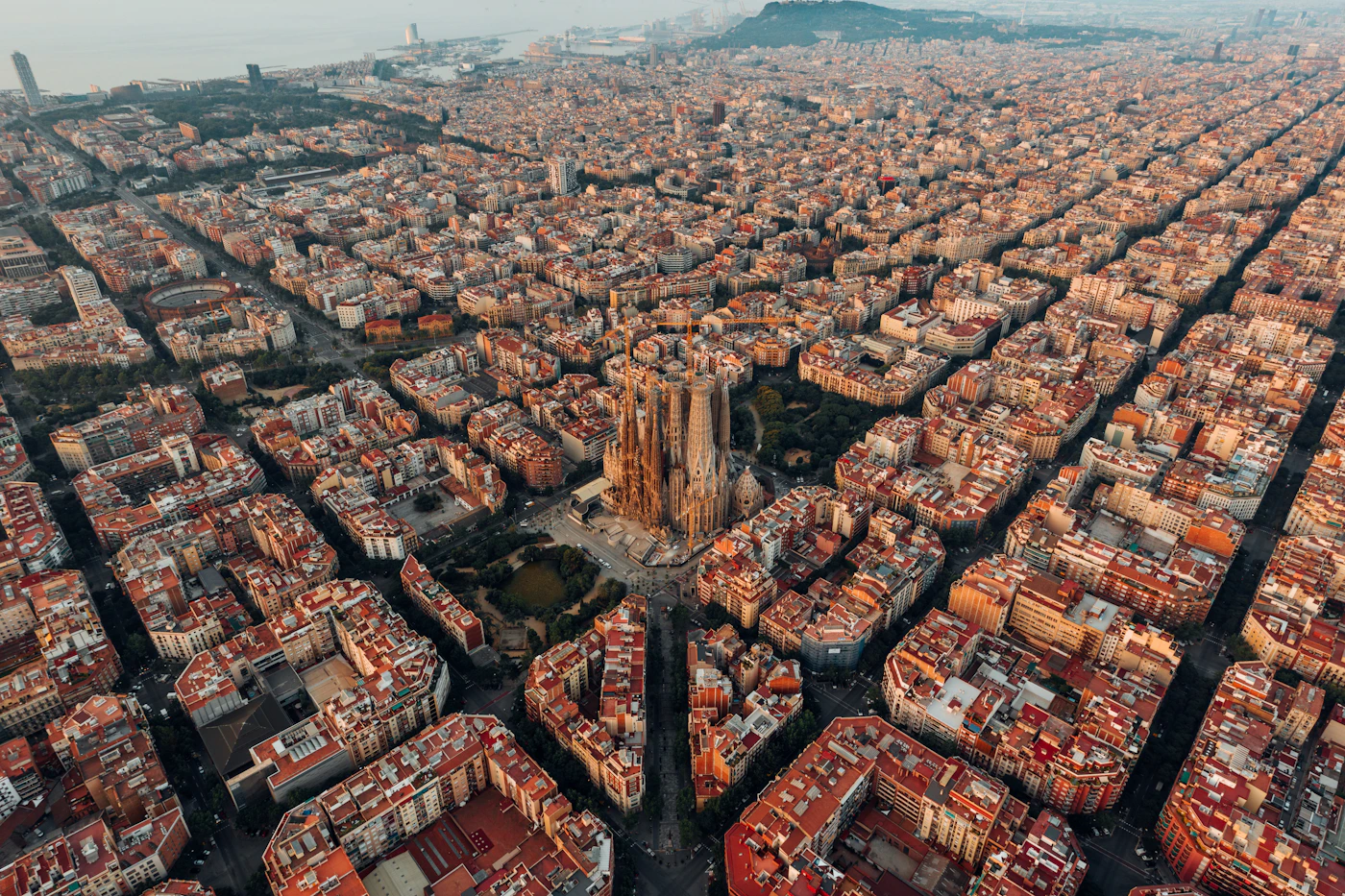
If you walk this branch into your day, do it in the late afternoon. The narrow streets in the Born hold heat in summer and shade in winter; the Moco's stone courtyard is the coolest place on the block by three in the afternoon, and exiting back onto Montcada at six brings you into the Born's evening, which is when the district is actually pleasant to walk. From the Moco entrance, ten minutes south brings you to the harbour; ten minutes north into the Gothic Quarter; twenty minutes west into the Raval. All on foot, no metro needed.
London — Marble Arch
The London Moco is the newest of the three, near Marble Arch on the western edge of Hyde Park. The building is a renovated commercial space — not historic in the Amsterdam or Barcelona sense, but adapted with attention. From the outside, it is the most contemporary-looking of the three, and the only one that announces itself with the kind of signage that you would not see on the original.
The block around it is the most generic of the three. Hotels, office buildings, the standard infrastructure of central London. There is no medieval stone here, no canal, no townhouse. The neighbourhood does its work elsewhere — Hyde Park to the south, Oxford Street to the east, the residential streets of Marylebone to the north — and the Moco sits at the intersection of those neighbourhoods rather than within any one of them.
This is, in practice, the easiest of the three to fit into a London day. The Central Line stops at Marble Arch; the museum is a two-minute walk from the underground exit. You can walk through Hyde Park afterwards, or up to Oxford Street, or into Marylebone for dinner. The Moco is, in this sense, very London: a destination, not a neighbourhood.
Hours and what to expect
All three locations are open every day. The exact hours vary by city and by season, but the pattern is consistent: morning through evening, longer on weekends, often with late closings on Fridays and Saturdays that no other museum in the same city offers. The current hours, exhibits, and addresses are on the Moco Museum's own site, which I check before each visit. I do not duplicate their listings; I trust them to keep their own information current.
The collections rotate, so what I saw in Amsterdam in April is not what you will see in Amsterdam in October. The overall stylistic territory — modern and contemporary, weighted toward Banksy, Warhol, Haring, Kusama, KAWS, Arsham, and rotating contemporary names — is consistent across the three buildings, but the specific works move. If you are a completist, you would want to check the website to know what each branch is currently showing.
Which one to pick
If you have a choice and no other constraint, pick by city, not by museum. The Moco's three branches show similar enough work that the differentiator is the walk around the building. The Amsterdam branch is the most architectural in its neighbourhood context (Museumplein, Concertgebouw, the Rijksmuseum nearby). The Barcelona branch is the most beautiful as a building. The London branch is the most efficient if you are already on a London itinerary. Choose the city you are already going to visit, and let the Moco be one of the stops, not the reason for the trip.
And bring a notebook. The contemporary art is what is on the walls, but the streets around the museum are what you will remember.